Architecture Best Practices for Legacy Modernization
Architecture as the Bridge Between Strategy and Delivery
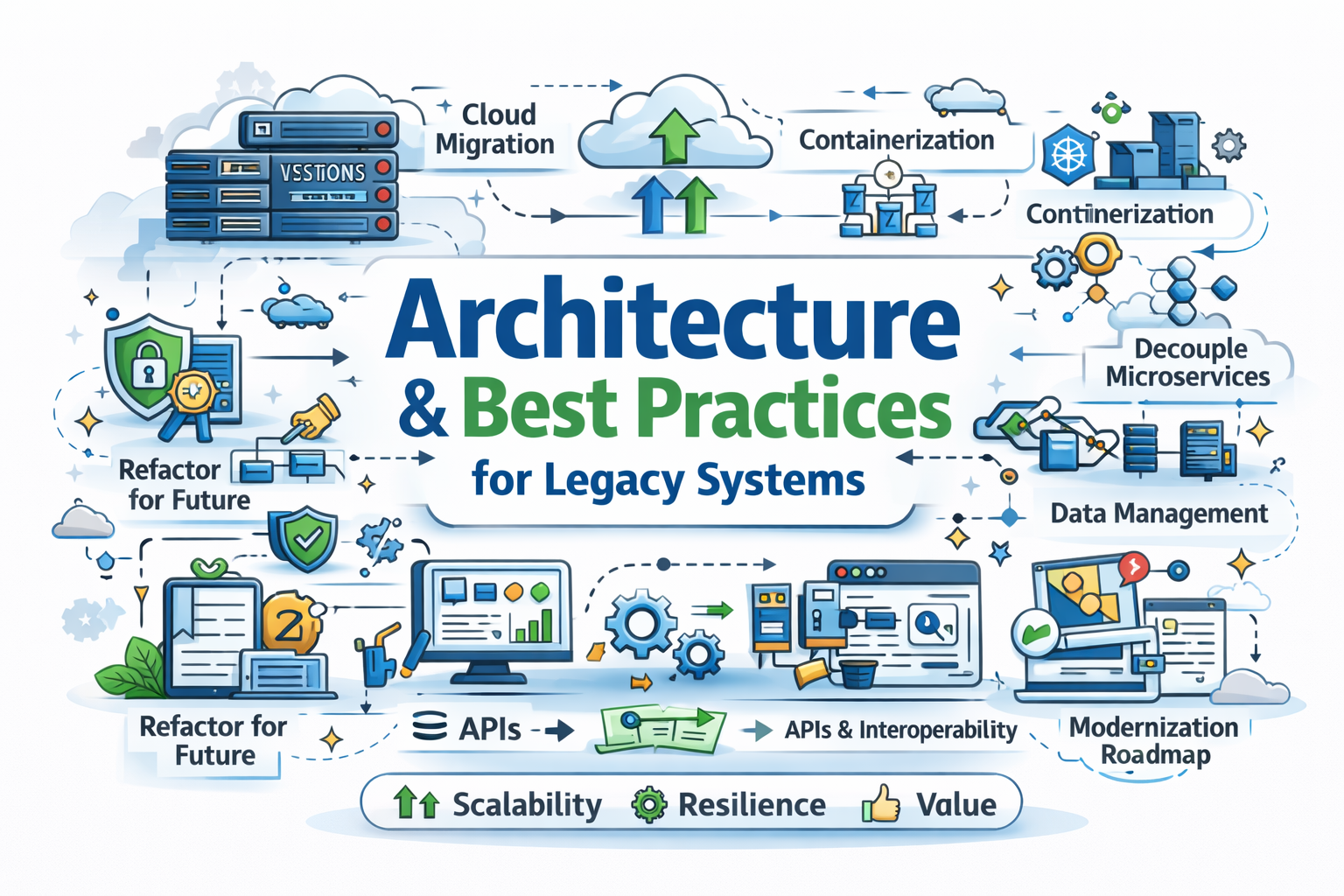
Strategies set direction, assessments expose constraints, but architecture makes modernization tangible. Poor architectures copy yesterday’s bottlenecks into tomorrow’s stack. In this guide we translate modern architectural principles into step-by-step practices with stories from real programs, AI augmentation tips, and plenty of diagrams.
Domain-Driven Design (DDD) Revisited for Legacy
DDD is less about jargon and more about aligning software models with business language. When modernizing legacy systems, DDD helps break monoliths into meaningful domains.
Running Collaborative Modeling Sessions
- Event storming: Post-it sessions capturing domain events, commands, aggregates, and policies.
- Context mapping: Show upstream/downstream relationships and translation layers.
- Capability alignment: Map strategy objectives (Strategy & Vision) to domain capabilities.
- AI transcription: Record workshops, then let an LLM summarize events, relationships, and open questions.
Mapping Legacy Code to Domains
Use static analysis + runtime telemetry to cluster modules by data access patterns. AI tools can read repository histories and suggest candidate bounded contexts: “Modules touching orders, invoices, and taxes cluster into a Billing context.” Validate with SMEs, then codify in ADRs.
Bounded Contexts: Guardrails for Teams
Bounded contexts encapsulate language, data, and models. Without them, modernization devolves into shared database chaos.
- Context contracts: Document APIs, events, and SLAs between contexts.
- Anti-corruption layers (ACLs): Shield new domains from legacy quirks.
- Team topology: Align teams to contexts, with platform teams covering cross-cutting layers.
Clean and Hexagonal Architecture: Ports, Adapters, and Discipline
Clean architecture emphasizes concentric layers; hexagonal architecture enforces ports and adapters. Both aim to isolate business logic from infrastructure.
Implementation Tips
- Define ports first: Use TypeScript/Java interfaces or OpenAPI specs to capture inbound/outbound contracts before coding adapters.
- Treat adapters as replaceable: database adapters, message adapters, and UI adapters should be swappable without touching core logic.
- AI code review: Ask an LLM to scan modules and flag direct infrastructure calls leaking into domain layers.
Microservices vs Modular Monolith: Deciding with Evidence
Modernization doesn’t mean microservices everywhere. A modular monolith can deliver the same domain separation with lower operational overhead.
Decision Factors
- Team size & cognitive load: Small teams benefit from modular monoliths.
- Deployment frequency: If domains need independent deploys multiple times per day, microservices win.
- Observability maturity: Without tracing and service mesh expertise, microservices hurt.
- AI maintainability forecasts: Use AI to simulate future change volume per domain; choose architecture that matches projected churn.
Event-Driven Architecture (EDA): Avoiding Rebranded Batch Jobs
Event-driven design becomes powerful when events are treated as first-class contracts.
- Event schemas: Versioned in Schema Registry/Git.
- Event choreography vs orchestration: Blend depending on domain coupling.
- Idempotency & ordering: Mandatory for financial domains.
- AI anomaly detection: Use ML to flag event storms, missing events, or schema drift.
API-First Design: More Than OpenAPI Specs
API-first modernization requires:
- Consumer-driven contracts: Pact/Backstage contracts stored centrally.
- Lifecycle governance: Design → Review → Mock → Implement → Observe.
- Portal & catalog: Document APIs, rate limits, ownership, error models.
- Security baked in: OAuth2 scopes, threat modeling for each endpoint.
Backward Compatibility & Versioning Strategies
Modernization fails when new systems break consumers. Strategies:
- Semantic versioning for APIs/events.
- Compatibility matrices describing supported versions.
- Transformers/Adapters that convert between legacy and modern payloads.
- Sunset policies with communication timelines.
Use AI to scan traffic logs and determine which clients still use old versions. Automate outreach with generated emails referencing real usage stats.
Versioning Data Models
Data evolves slower than services. Adopt:
- Schema evolution rules: additive changes first, then deprecations.
- CDC pipelines: propagate changes gradually.
- Temporal tables or event sourcing for auditability.
- Data contracts: enforce column-level expectations.
Contract Testing & Compatibility Playbooks
- Consumer-driven contracts: Tools like Pact, Specmatic, or custom JSON schema validators ensure providers honor consumer needs.
- Gateway shims: Inject lightweight shims in API gateways to rewrite headers/payloads for lagging consumers during transitions.
- Golden paths: Record canonical requests/responses and replay them through new versions to prove parity.
- SLAs for deprecation: Publish timelines (e.g., 90 days notice, 30-day warning, cutoff) and automate reminders with AI-generated outreach tailored to each consumer’s usage stats.
Platform Enablement for Architecture Consistency
Platform teams translate patterns into tools:
- Scaffolding CLI: spins up hexagonal service templates, wiring observability and security defaults.
- Policy-as-code: ensures every service registers with the API catalog, emits traces, and meets SLO baselines.
- Reference implementations: sample repos showing DDD + EDA patterns with CI pipelines.
- Architecture scorecards: automated checks in CI blocking merges if patterns are violated.
- AI prompt library: curated prompts for reviewing diagrams, ADRs, or code modules.
AI-Driven Architecture Guardrails
- Spec-to-code traceability: AI checks PRs against OpenAPI/AsyncAPI specs to ensure interfaces match approved designs.
- Graph intelligence: Feed service dependency graphs into graph neural networks to detect cycles or hidden shared databases.
- Incident correlation: AI maps incidents back to architecture violations (e.g., synchronous fan-out causing cascading failures).
- Design copilots: Chat interfaces where engineers paste diagrams, and the model flags missing resilience patterns.
Operationalizing Architecture Reviews
Replace ad-hoc review meetings with a pipeline:
- Submission: Teams provide ADR draft, architecture diagram, SLAs, and threat model.
- Automated checks: Lint diagrams, validate ADR completeness, run AI architecture critique.
- Peer review: Architecture guild reviews asynchronously, leaving comments.
- Decision sync: 30-minute session only if blockers remain.
- Knowledge capture: Publish learnings to the pattern catalog.
This reduces review cycles from weeks to days while keeping rigor.
Resilience Patterns Cheat Sheet
Tie resilience patterns to observability: every circuit breaker trip should emit structured events; AI agents can watch for thresholds and recommend scaling or refactors.
Reference Architecture Blueprint
Anti-Patterns to Watch
- Shared database as integration method: leads to tight coupling and unsafe migrations.
- God services: new “platform” service replicates monolith complexity.
- Chatty microservices: synchronous chains that reintroduce bottlenecks.
- DIY security: inconsistent OAuth implementations across services.
AI can spot these by scanning dependency graphs and commit histories.
Architecture Decision Records (ADRs)
Modernization programs live or die by decision memory. Keep ADRs concise:
- Context: Problem statement referencing KPIs.
- Decision: Strategy, chosen patterns, scope.
- Consequences: Trade-offs, follow-up tasks.
- AI assistance: Generate first drafts, but keep humans accountable for accuracy.
Coaching Teams on Patterns
- Pattern catalog: internal site describing DDD contexts, hexagonal templates, EDA guidelines.
- Guilds/communities: share wins, anti-patterns, and AI prompts.
- Mob architecture reviews: include engineers, SREs, security, and product.
- Architecture dojos: short sprints to practice new patterns before production.
Measuring Architectural Health
Automate data collection from GitHub, CI pipelines, and API gateways. AI agents can generate the scorecard weekly.
Case Study: Media Streaming Platform
- DDD mapped viewing, billing, recommendations, and advertising contexts.
- Hexagonal architecture ensured offline download logic shared core domain logic with streaming endpoints.
- Event-driven architecture delivered real-time personalization via Kafka + Flink.
- API-first approach let TV OEM partners integrate without custom code.
- Versioning kept legacy set-top boxes alive while mobile apps adopted GraphQL.
- AI copilots flagged when new services bypassed the event bus, preventing future coupling.
Example Benchmark: 35% faster feature delivery and 99.95% uptime during peak sports events.
Action Plan
- Facilitate DDD workshops with AI note-takers.
- Define bounded contexts, ACLs, and team mappings.
- Adopt hexagonal templates across services; enforce via scaffolding tools.
- Decide microservices vs modular monolith per domain using evidence.
- Stand up event schema governance with registries and CI validation.
- Build API lifecycle workflows integrated with security reviews.
- Establish compatibility guidelines, versioning policies, and telemetry dashboards.
- Automate architecture health scorecards and review monthly.
Looking Ahead
Architecture patterns only help if infrastructure can execute them. Next, we’ll modernize cloud and infrastructure foundations—IaC, containers, orchestration, and resilient environments.
Legacy Modernization Series Navigation
- Strategy & Vision
- Legacy System Assessment
- Modernization Strategies
- Architecture Best Practices (You are here)
- Cloud & Infrastructure
- DevOps & Delivery Modernization
- Observability & Reliability
- Data Modernization
- Security Modernization
- Testing & Quality
- Performance & Scalability
- Organizational & Cultural Transformation
- Governance & Compliance
- Migration Execution
- Anti-Patterns & Pitfalls
- Future-Proofing
- Value Realization & Continuous Modernization