Performance & Scalability Modernization: Designing for Predictable Throughput
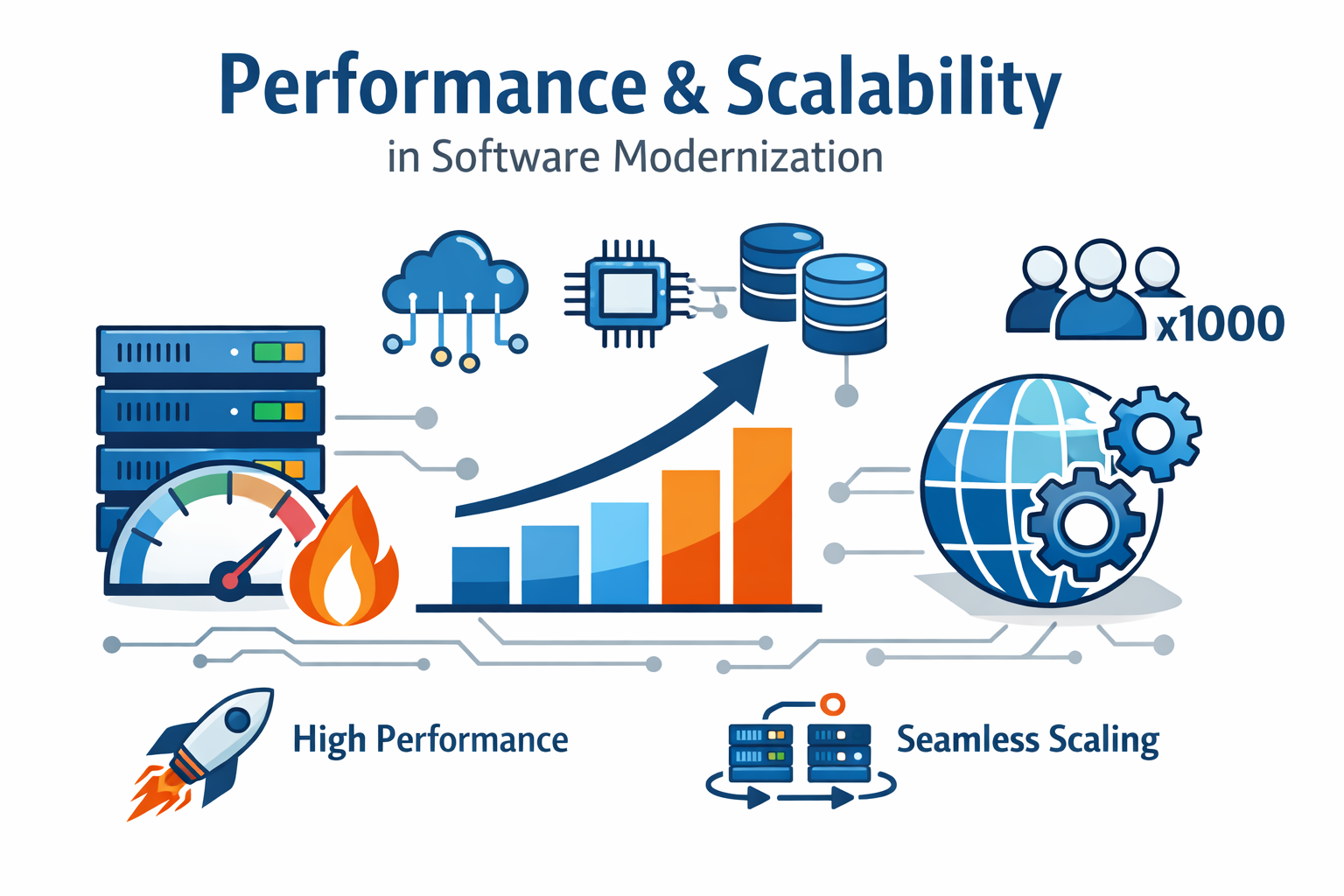
Scalability is a Discipline, Not a Cloud Checkbox
Legacy systems struggle under peak loads—tax season, Black Friday, IPO rushes. Modernization must guarantee throughput, latency, and cost predictability. This article covers horizontal vs vertical scaling, caching, load balancing, asynchronous processing, rate limiting, and capacity planning, all framed for BFSI realities and augmented by AI insights.
Performance Philosophy
- Measure before optimizing: instrumentation precedes tuning.
- Design for worst customer moment: plan for peak, not average.
- Capacity == Capability: treat performance budgets like financial budgets.
- Automation + AI: predictive scaling beats reactive scaling.
Horizontal vs Vertical Scaling
- Vertical (scale-up): simpler, but limited by hardware, licensing costs, maintenance windows.
- Horizontal (scale-out): requires stateless design, sharding, distributed caching, but offers resilience.
- Hybrid: vertical for legacy DBs, horizontal for app tiers.
BFSI Example: Treasury Risk Engine
- Initially scaled vertically; nightly Monte Carlo simulations exceeded window.
- Transitioned to horizontal cluster using Kubernetes + Spark; dynamic node pools triggered via AI forecasts.
- Extended licensing via processor-based tokens, cutting runtime from 6h to 1.5h.
Caching Strategies
- Edge caching: CDN for public content, digital statements.
- Application caching: in-memory caches (Redis, Hazelcast) for reference data.
- Database caching: query result caches; caution with consistency.
- Write-through vs write-back: choose per workload; BFSI often favors write-through for auditability.
- TTL policies: align with product rules (FX rates refresh every minute).
Load Balancing Patterns
- Global traffic management: DNS-based (Route 53, Akamai GTM) for multi-region routing.
- Layer 7 balancing: application-aware routing with sticky sessions, path-based rules.
- Layer 4 balancing: TCP-level for legacy protocols.
- Service mesh: fine-grained load balancing, circuit breaking, retries.
- Observability: log request distributions, failover events.
Asynchronous Processing
- Queues & streams: Kafka, Pulsar, SQS for decoupling.
- Event-driven workflows: orchestrate long-running tasks (loan underwriting) without blocking.
- Back-pressure: implement consumer lag alerts; auto-scale workers.
- Idempotency: crucial for financial operations; track message IDs, dedupe tables.
Rate Limiting & Throttling
- Global vs per-client: protect platform and prevent abuse.
- Token bucket/leaky bucket: implement fair-share.
- Regulatory considerations: some APIs (open banking) must enforce per-bank quotas.
- Feature flags: adjust limits during incidents; communicate to partners.
Performance Testing & Benchmarking
- Benchmark harnesses: reproduce key workloads (ACH settlement, card auth) with realistic data.
- Latency SLOs: P95/P99, median, tail analysis.
- Resource efficiency: track cost per transaction.
- AI-driven anomaly detection: highlight regressions tied to deployments.
Capacity Planning with AI
- Inputs: historical load, seasonality, marketing campaigns, regulatory deadlines.
- Models: Prophet, ARIMA, gradient boosting, or custom ML.
- Outputs: recommended node counts, database IOPS, network bandwidth.
- Integration: IaC pipelines apply reservations, schedule tests.
Cost Optimization vs Performance
- Dynamic scaling: use predictive scaling, not manual toggles.
- Right-sizing: monitor CPU/memory utilization; downscale off-peak.
- Workload isolation: separate noisy neighbors via dedicated node pools.
- Spot/RI mix: apply Savings Plans for steady load, spot for burst.
Observability for Performance
- RED metrics: rate, errors, duration.
- Golden signals: meltdown budgets for key services.
- Profiling: continuous profilers (eBPF, Pyroscope) in production.
- Business correlation: link latency spikes to conversion, rejection rates.
BFSI Case Study: Digital Wallet Hypergrowth
- Challenge: holiday spikes crashed wallet top-ups.
- Actions:
- Introduced multi-tier caching (edge + Redis) for balances.
- Implemented adaptive rate limiting per merchant, per device.
- AI capacity planning triggered pre-scaling two days before expected spikes.
- Async ledger updates decoupled from push notifications.
- Result: handled 10x load with <400ms P95 latency; zero downtime.
BFSI Case Study: Capital Markets OMS
- Upgraded OMS to microservices with partitioned order books.
- Deployed load-aware routing (Kafka partitions + linkerd load balancing).
- Introduced flow control: rate-limited clients causing runaway orders.
- Performance telemetry fed regulators verifying best-execution compliance.
Scalability Patterns per Domain
Architecture Considerations
- Stateless design: store session state in redis/in-memory grid.
- Data partitioning: shard by region, customer, or product.
- Back-pressure: use circuit breakers + queue thresholds.
- Bulkhead isolation: allocate compute pools to protect critical services.
Performance Governance
- Performance review board: architects, SRE, product, finance.
- Performance budgets: each service has latency/CPU budgets; new features must operate within.
- Release gates: block deployment if performance regression > threshold.
- Post-incident analysis: root cause templates include performance dimension.
Tooling Stack
AI Copilots for Performance
💡 AI Assist Pattern
Use an AI-assisted analyzer (LLM + vector context from repos, tickets, and runtime traces) to surface modernization candidates automatically. Feed architecture rules, past incidents, cost telemetry, and code smells into the prompt so the model proposes risk-ranked remediation steps instead of generic advice.
Additional plays:
- Bottleneck diagnosis: AI analyzes traces/profiles, highlighting specific functions.
- Scaling recs: suggests new auto-scaling rules based on demand curves.
- Cache tuning: patterns detect low hit rates and propose eviction adjustments.
- Rate limit modeling: simulate attack vs traffic bursts to refine thresholds.
Capacity Playbook (Quarterly)
- Review KPIs (latency, throughput, cost per transaction).
- Analyze incidents/perf regressions.
- Update traffic forecasts with business calendars.
- Adjust scaling policies, reservations, and budgets.
- Run DR/performance drills (region failover + load).
Action Plan
- Instrument services with standardized metrics and tracing.
- Baseline current throughput, latency, and resource cost per service.
- Implement caching, load balancing, and async design patterns where needed.
- Deploy rate limiting and back-pressure controls for critical APIs.
- Automate performance testing and integrate results into deployment gates.
- Build AI-driven capacity planning dashboards tied to IaC.
- Run quarterly performance governance reviews aligned to business peaks.
Looking Ahead
With systems performing predictably, we can now focus on organizational and cultural transformation to sustain modernization.
Legacy Modernization Series Navigation
- Strategy & Vision
- Legacy System Assessment
- Modernization Strategies
- Architecture Best Practices
- Cloud & Infrastructure
- DevOps & Delivery Modernization
- Observability & Reliability
- Data Modernization
- Security Modernization
- Testing & Quality
- Performance & Scalability (You are here)
- Organizational & Cultural Transformation
- Governance & Compliance
- Migration Execution
- Anti-Patterns & Pitfalls
- Future-Proofing
- Value Realization & Continuous Modernization