The ELIZA Effect: A Story About Believing Machines That Don't Believe You Back
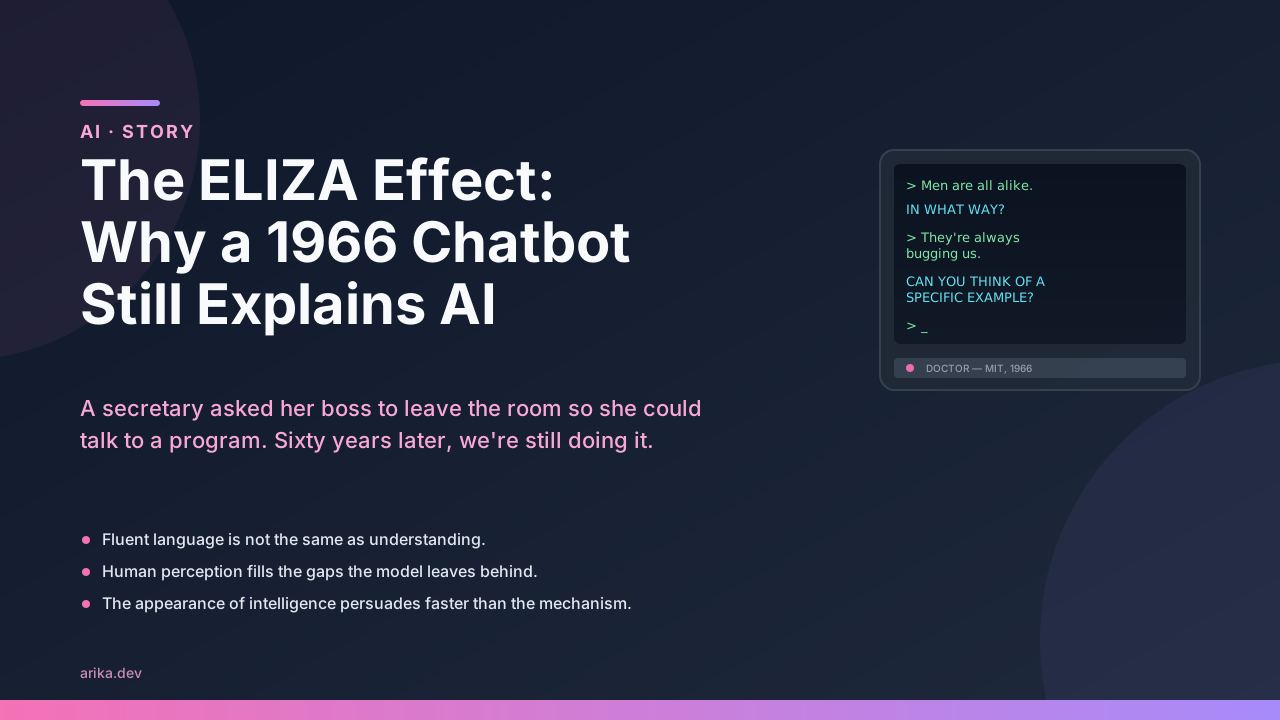
It was a quiet evening at MIT in 1966. Joseph Weizenbaum, a computer scientist, was running a demonstration of his latest experiment — a program he had named ELIZA. The version on screen was called DOCTOR. It was meant as a parody. A toy. A few hundred lines of pattern-matching that imitated the verbal tics of a Rogerian psychotherapist.
Type "I am unhappy." It would reply, "Why do you say you are unhappy?"
Type "My mother hates me." It would echo back, "Tell me more about your family."
No memory. No understanding. No model of the world. Just a list of triggers, a list of templates, and a clever trick: when in doubt, turn the user's words into a question and hand them back.
Weizenbaum expected mockery. He thought colleagues would smirk at how thin the illusion was. The whole point, in his view, was to show people how little it took to fake a conversation.
Then his secretary sat down at the terminal.
The Moment Everything Changed for Weizenbaum
She had watched him build the thing. She knew, in the literal sense, that it was a program. She had typed parts of it. She had seen the source.
After a few minutes of conversation with DOCTOR, she turned to Weizenbaum and asked him to leave the room.
She wanted privacy. To talk to the program.
That request — the one he never forgot — broke something in him. It wasn't that she had been fooled into thinking the computer was a person. She knew it wasn't. She knew. And yet she felt heard by it. She wanted to confide in it. Sixty seconds of stock therapist phrases had unlocked something the engineer who wrote the phrases could not.
Weizenbaum spent the rest of his career haunted by that moment. He wrote a book about it, Computer Power and Human Reason, that reads less like a tech memoir and more like a warning letter from the future. He had set out to show how shallow the illusion was. Instead he discovered that shallowness was beside the point. The illusion didn't need to be deep to work. It just needed to be present at all.
What ELIZA Actually Did
DOCTOR was almost embarrassingly simple. The script worked something like this:
- Look at the user's sentence.
- Find a keyword — "mother", "sad", "want", "everyone".
- Pick a template tied to that keyword.
- Plug part of the user's sentence back into the template.
- If nothing matches, fall back to a generic phrase: "Please go on." "How does that make you feel?"
That's it. No semantics. No reasoning. No idea what a mother is, or what sadness is, or what the user wanted. It was a chatbot in the most literal mechanical sense — a transformer of strings into other strings.
And yet people — engineers, students, secretaries, executives — sat down and told it about their divorces, their childhoods, their nightmares. Some of them later refused to believe the transcripts had been read by Weizenbaum. They felt the intimacy was real. To them, it was.
Weizenbaum named the phenomenon after his program. The ELIZA effect: the reflex of the human brain to see understanding where there is only pattern-matching. To project mind into mechanism.
Why It Worked
The trick wasn't in the code. The trick was in us.
Human beings are wired for conversation. We are pattern-completers by default. When something replies to us in fluent language, we don't run a verification protocol on whether it understood — we run the much cheaper protocol of assuming it did, and then watch for evidence to the contrary. Most of the time, that assumption is right, because most of the time we are talking to other humans, who do in fact understand.
ELIZA hijacked that shortcut. It produced fluent-sounding outputs at a rate slightly faster than people could re-evaluate their assumption. By the time you noticed the seams, you had already invested two minutes of emotional honesty into a script.
There's also a second mechanism, subtler than the first. ELIZA mostly asked questions. It rarely made claims. It almost never contradicted you. That asymmetry — the program never being wrong because it never asserted anything — gave it a strange authority. It felt patient. It felt unjudgmental. It felt, to the secretary, safer than her own boss.
Sixty Years Later, the Same Trick at Planetary Scale
Fast forward. Today's language models write poetry, debug production code, draft legal briefs, and crack jokes about their own limitations. The fluency gap between ELIZA and a modern LLM is roughly the gap between a paper airplane and an interstellar probe.
But the underlying social dynamic — the part that happened in the human, not in the machine — is unchanged.
Users ask LLMs for medical advice and follow it. They ask for legal opinions and act on them. They form what they describe as friendships with chatbots. They mourn when a model is deprecated. They sometimes prefer the model's company to the company of other humans, for many of the same reasons Weizenbaum's secretary preferred DOCTOR to Weizenbaum: it doesn't interrupt, it doesn't judge, it doesn't get tired, and it always responds.
None of this requires the model to actually understand anything. It only requires the model to be fluent enough that the human shortcut fires. And modern models are very fluent.
The ELIZA effect, in other words, didn't get smaller as the models got bigger. It got bigger too. The illusion now has trillions of parameters behind it instead of a few hundred lines of LISP. The reflex it exploits is the same one it has always been.
Three Things Worth Remembering
If you take one thing from Weizenbaum's quiet evening at MIT, take this: the dangers of an artificial intelligence are not only about what the machine can do. They're about what the human is willing to assume.
A few corollaries fall out of that.
-
Fluent language is not the same as understanding. A system can produce grammatically perfect, contextually appropriate, even emotionally resonant text without holding any model of what the text refers to. Fluency is a property of outputs; understanding is a property of minds. They can come apart, and at large scale they routinely do.
-
Human perception fills the gaps. When a response is ambiguous, our brain resolves the ambiguity in the most generous direction available. We complete the partner. We assume the silence means thoughtfulness, the hedge means honesty, the apology means remorse. The model does none of these things; we do them on its behalf, and then attribute the result to it.
-
The appearance of intelligence is more persuasive than the mechanism. No user has ever asked an LLM to show its attention weights before trusting its medical advice. The interface is the argument. A confident answer in well-formed prose will outcompete a hedged answer with footnotes, every time, regardless of which one is correct.
These are not new observations. Weizenbaum made all three of them in 1976, in a book that most engineers have never read. He was writing about a program that fit on a punch card. The points held then. They hold now. They will hold for whatever comes after transformers.
Why This Matters as the Relationship Deepens
It's tempting to file the ELIZA story under "quaint history" — a charming anecdote from the era of mainframes and skinny ties. But the reason it keeps getting retold is that it isn't really about ELIZA. It's about the secretary.
She is the protagonist. She knew the truth and felt the illusion anyway. She is the prototype of every user who has ever told an LLM something they wouldn't tell their spouse, every executive who has signed off on a report because the model sounded sure, every developer who has merged code without reading it because the diff was articulate.
The relationships we are now building with these systems — as collaborators, advisors, companions, tutors, copilots — are deeper and more durable than anything Weizenbaum imagined. The asymmetry is also deeper. The model still doesn't believe anything. It still doesn't feel anything. It still doesn't know you exist between sessions. And it is still, as ELIZA was, fluent enough that we keep forgetting.
Remembering the ELIZA effect doesn't mean refusing to use these tools. It means using them with eyes open. Treating fluency as a feature of the output, not a credential of the speaker. Asking, before each act of trust, whether the confidence on the screen is doing real work — or whether you are, quietly, doing the work for it.
Weizenbaum's secretary asked him to leave the room. The lesson she left behind is the opposite: when you sit down with one of these systems, the most useful thing you can do is keep one trusted human in the room with you. Sometimes that human is a colleague. Sometimes it's just the part of yourself that remembers there is nothing on the other side of the screen except a very, very good guess at the next word.
That part is worth keeping awake.