Java 8: The Functional Programming Revolution
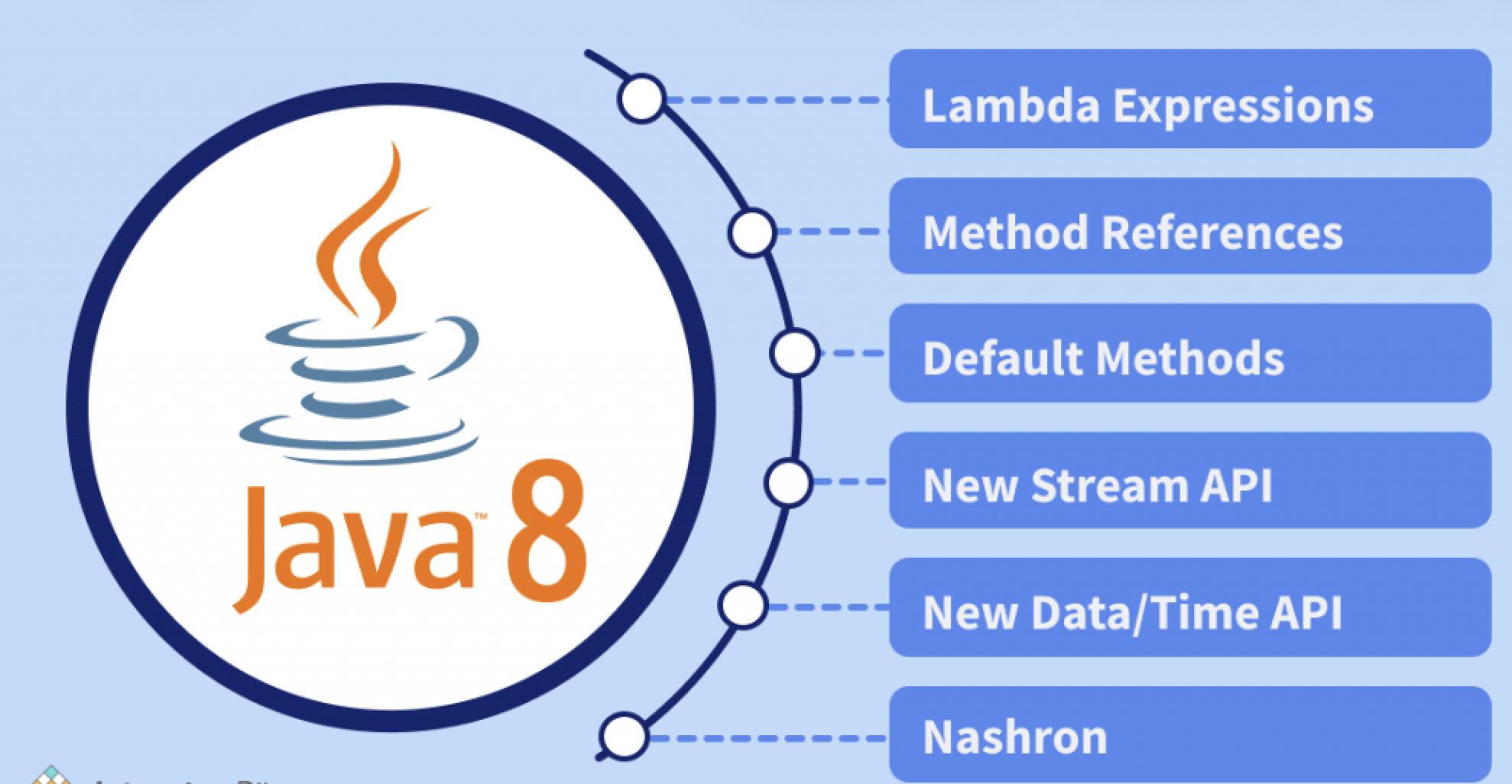
Java 8: A Game-Changing Release
Java 8 (March 2014) marked a paradigm shift in Java development by introducing functional programming concepts. This release fundamentally changed how developers write Java code.
1. Lambda Expressions
Lambda expressions allow you to write concise, functional-style code by treating functions as first-class objects.
Before Java 8:
// Old way with anonymous inner classes
button.setOnClickListener(new OnClickListener() {
    @Override
    public void onClick(View v) {
        System.out.println("Button clicked!");
    }
});

// Sorting with Comparator
List<String> names = Arrays.asList("Alice", "Bob", "Charlie");
Collections.sort(names, new Comparator<String>() {
    @Override
    public int compare(String a, String b) {
        return a.compareTo(b);
    }
});
After Java 8:
// Clean lambda expression
button.setOnClickListener(v -> System.out.println("Button clicked!"));

// Simple sorting
List<String> names = Arrays.asList("Alice", "Bob", "Charlie");
Collections.sort(names, (a, b) -> a.compareTo(b));
2. Functional Interfaces
A functional interface is an interface with exactly one abstract method. Lambda expressions can implement functional interfaces.
// Functional Interface
@FunctionalInterface
public interface Calculator {
    int calculate(int a, int b);
}

// Using lambda expressions
Calculator add = (a, b) -> a + b;
Calculator multiply = (a, b) -> a * b;

System.out.println(add.calculate(5, 3));        // Output: 8
System.out.println(multiply.calculate(5, 3));  // Output: 15
3. Streams API
The Streams API revolutionized data processing by enabling functional-style operations on collections.
List<Integer> numbers = Arrays.asList(1, 2, 3, 4, 5, 6, 7, 8, 9, 10);

// Before Java 8: Imperative approach
List<Integer> evenNumbers = new ArrayList<>();
for (Integer number : numbers) {
    if (number % 2 == 0) {
        evenNumbers.add(number * 2);
    }
}

// After Java 8: Declarative approach
List<Integer> evenNumbers = numbers.stream()
    .filter(n -> n % 2 == 0)
    .map(n -> n * 2)
    .collect(Collectors.toList());

// Advanced example: grouping and reduction
Map<String, Integer> scoreMap = employees.stream()
    .collect(Collectors.groupingBy(
        Employee::getDepartment,
        Collectors.summingInt(Employee::getSalary)
    ));
4. Method References
Method references provide an even more concise way to refer to methods.
List<String> names = Arrays.asList("Alice", "Bob", "Charlie");

// Using lambda
names.forEach(name -> System.out.println(name));

// Using method reference (cleaner)
names.forEach(System.out::println);

// Chained operations
List<Integer> sorted = numbers.stream()
    .filter(Objects::nonNull)
    .sorted()
    .collect(Collectors.toList());
5. Default Methods in Interfaces
Interfaces can now have concrete methods with default implementations.
public interface PaymentProcessor {
    void process(double amount);

    // Default method - can be overridden
    default void log(String message) {
        System.out.println("[LOG] " + message);
    }
}

public class CreditCardProcessor implements PaymentProcessor {
    @Override
    public void process(double amount) {
        log("Processing credit card payment: $" + amount);
        // Process payment
    }
}
6. Optional Class
Optional eliminates the need for null checks and reduces NullPointerException errors.
// Before Java 8: Null checks everywhere
User user = getUserById(1);
String email = null;
if (user != null) {
    email = user.getEmail();
}

// After Java 8: Optional
Optional<User> user = getUserById(1);
String email = user.map(User::getEmail)
    .orElse("guest@example.com");

// Chaining operations
user.filter(u -> u.isActive())
    .map(User::getEmail)
    .ifPresent(System.out::println);
Developer Impact
Positive:
- Concise Code: Dramatically reduced boilerplate code
- Readability: Clearer intent with declarative style
- Performance: Parallel streams for multi-core processing
- Easier Testing: Functional style is easier to test
// Example: Processing large dataset efficiently
List<Integer> result = hugeList.parallelStream()
    .filter(n -> n > 1000)
    .map(n -> n * 2)
    .collect(Collectors.toList());
Pros and Cons
Pros ✅
- Functional Paradigm: Introduces functional programming to Java
- Cleaner Code: Reduced anonymous classes and boilerplate
- Better Performance: Parallel streams leverage multi-core processors
- Composable Operations: Chain operations elegantly
- Null Safety: Optional prevents NullPointerException
- Default Methods: Adds flexibility to interface evolution
Cons ❌
- Learning Curve: Developers from imperative backgrounds find it challenging
- Stream Overhead: Can be slower than imperative loops for small collections
- Debugging Difficulty: Stack traces are harder to read with lambda expressions
- Performance Trade-off: Parallel streams have overhead for small datasets
- Immutability: Encourages immutable state, which has performance implications
Conclusion
Java 8 transformed Java from a purely object-oriented language into a multi-paradigm language. The introduction of lambdas, streams, and functional interfaces made Java code more concise and expressive. This release is considered one of the most important updates in Java history.
When to use:
- Use lambdas and functional interfaces for cleaner, more readable code
- Use streams for collection processing instead of traditional loops
- Use Optional when dealing with potentially null values
- Use parallel streams for processing large datasets on multi-core systems